
• Skip to primary navigation
  • Skip to main content
  • Skip to primary sidebar
  • Skip to footer
Moving Into Harmony

Moving Into Harmony

MOVEMENT & BREATHING: HEALTH / PERFORMANCE PROGRAMS

  • BREATH’S POWER
  • GOT PAIN?
  • BLOG
  • CLASSES, COURSES & WORKSHOPS
    • HATHA YOGA RESOURCES
  • ABOUT SHAWN
  • CONTACT ME

Shawn M Flot

Are you strong enough and ready for your adventure?

August 19, 2021 by Shawn M Flot

Breathing is essential to Men’s Health

A vital question for men and men’s health – Is your tent still erect at sunrise?
Are you up and ready to meet the the adventure of the day?
Or is it too much effort to rise to what’s lies ahead of you?
For men’s health this has many levels of relating to your health, vitality and feelings of security in your relationship. Even in the field of physical therapy, Men’s Health magazine explains how erectile function is impacted by breathing and the pelvic floor.

For women who care about their man’s health & well-being – how does your man rise in the morning? How is the tent post…..under the covers? or is he groogy, slow to move, run down and unable to be motivated for the day’s adventure?

This is a subject a lot of men and women are shy to talk about. Erectile Dysfunction, or ED as the mainstream try to streamline the taboo and insecurities around the word – erect. And if you shelter up in the wild backcountry, exploring great adventures, you understand the importance of a secure erect shelter, or tent.

For men’s health, the morning of a good erection is the sign of a healthy pelvis, and a great day of adventure ahead. How can this be you ask? Let’s explore this vital topic.
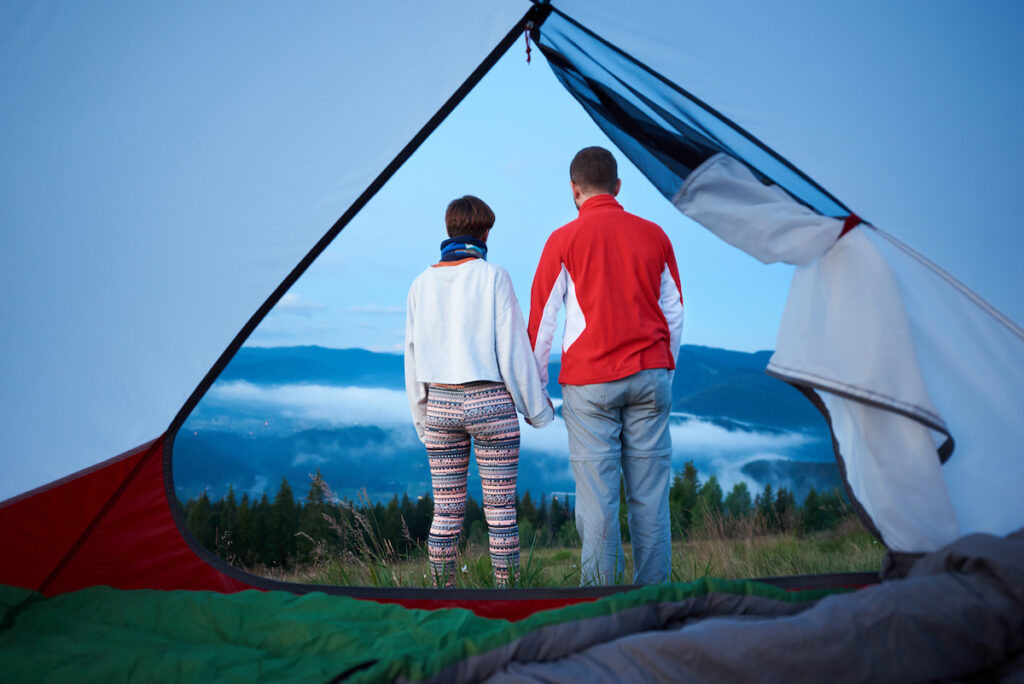
Rear view of two young people holding hands enjoy the morning scenery of the mountains on which the fog descended. View from inside a tent

And one the repeated message I hear when studying with Patrick McKeown – breathing expert, master teacher and author of several books on Breathing Health & Performance – is one sign of a man’s good health can be measured by the natural erection that occurs in the morning upon waking. Yes, a good sleep allows dependent on your breathing determines your ability to rise to all occasions and adventure ahead of you.

At this point in the interview Patrick McKeown, founder of the Oxygen Advantage, talks about breathing and erectile dysfunction

Sleep is the number one vital component for a successful and enjoyable adventure. It out-weighs the weight of the pack on your back, the food you prepare and devour, or how many miles you travel that day. Without the proper sleep, your body will not recover and the consequences of less than vital capacities leaves you at risk, less that able to perform, and worse …. unable to rise to the occasion when the adventure needs you the most.

What makes for good quality sleep? Let’s unpack the components that can make sleep optimal for you:

Quality

“I had a good night’s sleep”

How do you know? You may feel okay because you have habituated to the quality of sleep you are missing!

Do you wake up with a tent propped? Doesn’t have to be every morning but more than not, I suggest your erectile nature in the wakeup is indicative to your body getting the rest and circulation it needs. You can’t make love, have sex, when you are running from a tiger!

Refreshed feelings, clear head & eyes, flexible body, moist mouth, and a great BOLT score (click here to measure) are good measures to a good night’s restorative sleep. The BOLT score is especially important if you are exploring at altitude to see how well you are acclimatizing to the higher terrain and thinner air.

Breathing & Sleep

How your breathing at night has a major effect on how you recovered during sleep AND how much resources you have available for the day ahead.

How you feel and the circulation in your pelvis relates directly to how your breathing was in the night.

You may want to ask your partner you are sharing a tent with if there was noise. It can be from the mouth….VERY BAD!!! or it can come from a shut mouth……GOOD! but a very turbulent nasal breath……BAD!

I suggest to everyone to trial mouth taping during the day, to avoid freak out at night pulling the tape off your lips….ouch! and then mouth tape at night and compare how you feel….and perhaps if something is now holding the tent up.

Deep recovery and deep restoration during sleep require quiet and soft breathing. This is often a very under-valued part of your adventure. It can make or break your trip. Nocturnal hypoxia is the number one factor in people who get high-altitude sickness and don’t do well.

Day =>>> Night

How you breathe during the day determines how you breathe at night. The biggest change you can make is to breathe thru your nose unless your activity gets very intense. Surprisingly your ability to breathe thru your nose, especially at night is directly related to your pelvic health…. men’s health.

If you had a very taxing day and there was a lot of labored, heavy breathing, then the night time will be somewhat more turbulent or even loud.

It is best to cultivate a daily functional breathing pattern that incorporates the appropriate type of breathing for the level of the activity.

The gears of breathing are related to the intensity of the exercise or activity. If you can address habitual tendencies with awareness of how your breathe AND know what types of breathing to match the intensity instead of default you can remarkably improve your capacity and your ability to minimize the suffering, that unfortunately gets accepted when you are exploring the great outdoors with everything on your back.

Breathing is primary, and if it suffers the fate of unconditioned response, then you will suffer unnecessarily; your confidence goes down, AND more importantly you loose the memory of a good trip because your mind had to deal with you suffering; and surviving your unnecessary suffering does not make you a great explorer.
Filed Under: Insights, Moving Into Harmony, Oxygen Advantage, The Breath Tagged With: bones, health, wellness

Why relaxing down enhances your flexibility

November 20, 2020 by Shawn M Flot

If the well is distant, its water does not quench the thirst of the pilgrim – Chinese Proverb

Your health is being flexible, and your flexibility is not about how your stretch……it’s about how you descend to harness fluidity in your tissues and your mind. Just like in the desert, or in the mountains, the well-spring of nourishment is always found in the hollows of the earth – the canyon, the mountain, the well.

How do you harness your fluidity? You learn to descend within the body. My teacher, Shandor Remete, from the beginning, guided us to cultivate the ability to descend our energy by the proper use of how you move your body. So much of life triggers us to ascend upward – for example:

  • The overuse of the eyes and the brain.
  • A surprising and often frightening sensation of pain
  • Being “ready” for what’s expected or ahead of you
  • Holding yourself upright to maintain a “good” posture
  • elevate your mind for clear thoughts.

This is in contrast to the actual nourishing element of water that keeps us flexible, mobile, and agile. The higher you live, the more distant the access to the balancing mechanism that promotes dynamic fluidity. Water travels down the mountain, down the canyon, and eventually to the ocean. The physiological processes are related to natural phenomena – as in the natural wild world, so inside the wilderness of your body.

Dripping water can eat through a stone – Chinese Proverb

The “region” of the body that relates to the downward force to access the elemental nature of water, consists of approximately 70% of your total body. It represents – the back body – from the tuft of the skull to the heels; and the front body – from the navel to the front of the ankle. The gross body part, anatomical, that relates to the water element is the feet. The ankles are referred to as “the regulators of all fluids in the body” (wisdom given to me by both my Hatha Yoga teacher, Shandor Remete; and my Manual Therapy teacher, Frank Lowen).

What practices can you “exercise” to harness your fluidity? Good question.

Avoid Stretching what you think is tight.

Shocked? Consider how long you have been stretching to feel flexible? Now consider how much strain and stress you are putting on those pinpoint focused areas you feel are tight, without the aide of harnessing your fluidity. Your:

  • bottoms of your feet (plantar fascia)
  • calves (gastrocs, soleus)
  • thighs – front (quadriceps); back (hamstrings)
  • low back (quadratus lumborum, back extensors, spine)
  • hips – front (iliopsoas); back (glutes, piriformis)
  • shoulders (rotator cuff)
  • chest (pectoralis group)
  • neck and skull (trapezius, suboccipitals)

Some of you even contract one muscle group to stretch the apposing. Or you contract the muscle group you want to stretch, then relax to stretch it (cuz you think it fatigues that you can pull it apart more). Well, I am here to say…….

That is a lot of energy consumed to get a short term result. Doesn’t last. In fact the moment you return to your life that engages your up-ness. POOF! gone….you are back to being tight and probably feel more stiff than before you stretched.

Stretching, in my clinical experience is unnecessary stress and strain without the essential ingredient of dynamic fluidity. It is like a rubber band that snaps back. Consider the material – a rubber band, a piece of taffy – what happens when it is dry, frayed, or cold? It usually doesn’t have the same pliability, and if you are using a rubber band, I am certain you ignored that one or threw it away; or if it was the only one you had to use (you don’t have another hamstring) you were cautious to not overstretch because it break, and snap. Ouch, that end that snapped to my finger was painful. Ouch, I just “tore” my hamstring stretching in yoga class. And more subtly, your body is sensing undo stress and strain with it’s signals of ouch, protects by tightening (kinda like how your protecting brace when you know something potentially harmful is coming, or experienced) and tries to brunt the brute force attack by trying to stretch.

Learn how to use your feet and your ankles. And learn how to descend through squatting.

Yes squatting. It’s not what you think. Did you mind go to the power lifter in the gym squatting 300 lbs.? Admit it, you hesitated if you have read this far. You squat every day, many times a day. How many times do you sit down, and get up from a chair? How many times do you sit down to toilet? How many times do you lower yourself to get something? My suggestion is to use your every day activities to give yourself the opportunity to feel, discover, learn and integrate what you feel, or how you are guided to descend, that delivers a life benefit of the skill of descending to find your flexibility.

I will be discussing more details on this important topic in the weeks and months to come. Stay tuned.

You can also discover personalized ways

with a Telehealth Discovery Session

Find out more!

Filed Under: Insights, Moving Into Harmony, Yoga Tagged With: ankle, foot, health, movement, stretching, wellness

How to enhance your Balance & Coordination

November 13, 2020 by Shawn M Flot

YES!!!  Our feet and our hands have vital importance for integrative vital movement.

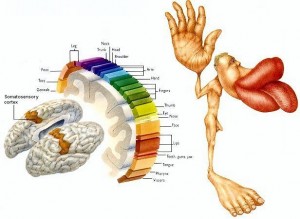
From a neuroscience perspective, the homunculus of the somatosensory cortex, the map of the motor and sensory fields in our brains, illustrate this occupancy of high functional capacities for the feet and hands. The only other areas that get this much “attention” are the lips, tongue, eyes, ears. With this representation, you can see the capacity we have to use our feet for sensation and developing attributes for the full-body movement that the body understands – the integration of the limbs. Most important is the capacity to feel, to sense your internal and external environments.

The tantric yogis, from which hatha yoga is a part of, state consciousness comes through or senses, and the “central nerve channel” derives the sensory system. Thus the importance for everyone to find their feet and develop a connection to the most important part of our foundation. And to sense and understand how the utilization of the hands is intimately connected to the spine and the legs.

What is not seen or measured is the ability to sense the bones, their alignment, and an integral part in our “core” stability. There is no need to bind the belly for stabilization. One only needs to feel how the spine responds to the balancing arrangement and integrative use of the limbs (including the head) for static and dynamic activity. It is this sensibility with the bones, all the way to the tips of the fingers and toes, that allows all the other tissues including tendons and muscle to respond together. The body knows how to respond with an integrative balance in the limbs. It is inherent. And to override the body’s intelligence and nature of functional core engagement is acting violently to the nature of the body’s resources. Developing a sensitivity to the bones requires advanced attention because the bones whisper and often their message gets drowned out by the message from the muscle.

I often associate the muscle with the mini-me, and the bones with the deep inner wisdom, or sage, that carries the innate intelligence of harmony in the body.

Filed Under: Insights, Moving Into Harmony, Yoga

  • « Go to Previous Page
  • Page 1
  • Interim pages omitted …
  • Page 5
  • Page 6
  • Page 7
  • Page 8
  • Page 9
  • Go to Next Page »

Primary Sidebar

Recent Articles

  • Beyond pain relief there is potential to do more
  • The Breath: Your Best Companion in Healing, Health & Performance
  • The truth about your breathing – the diaphragm Part 2

Categories

Footer

  • Facebook
  • Instagram
  • Vimeo
  • YouTube

Moving Into Harmony

109 S. 2nd Street
Talent, Oregon

Privacy Policy / Terms & Conditions / Disclaimer

Copyright © 2026 · Aspire 2.0.1 On Genesis Framework · WordPress · Log in