• Skip to primary navigation
  • Skip to main content
  • Skip to primary sidebar
  • Skip to footer
Moving Into Harmony

Moving Into Harmony

MOVEMENT & BREATHING: HEALTH / PERFORMANCE PROGRAMS

  • BREATH’S POWER
  • GOT PAIN?
  • BLOG
  • CLASSES, COURSES & WORKSHOPS
    • HATHA YOGA RESOURCES
  • ABOUT SHAWN
  • CONTACT ME

Insights

How to cultivate access to the Power in the Bones!

October 23, 2020 by Shawn M Flot

How do you consistently remain alive during life’s demands? How do you adapt? Are the adaptations you currently incorporate helping you live in harmony? Being alive is being fluid in response. Being alive is being in balance from the foundational support that your bones give.  Establish balance from a sustainable resource, the bones, and discover your potential.

Learning new patterns to replace habits that limit freedom of well-being can be challenging. Habitual patterns of posture for sitting and standing which unknowingly limit the flow of your circulation of life force energy, Prana, are perhaps the toughest to change. Typically, when there are changes required, we don’t realize how the bones can be that foundational support.

Life is challenging, sometimes overwhelming, sometimes eliciting means to survive. The body and mind do the best they can in the attempt to meet the demands from you and your environment. The stress response of the body, if elicited during these demands can diminish any biological and physiological healthy rhythms leading to symptomatic signals of unease. It is a resonance in the nervous system that registers dis-ease from unsupported activity. Symptoms such as difficulty sleeping, cold hands and feet, decreased appetite and difficulty digesting food all relate to an overwhelmed system.

A standing posture can be helpful in cultivating the supportive essential qualities for a path toward balance. Stances can also simultaneously aide in cutting and removing habitual “holding” patterns limiting your current state of being. Patterns developed from adaptations you needed and that may have been necessary during a certain time of your life. How you dealt with a demanding or stressful experience – survived, managed, or thrived. With a relaxed focus on the dynamisms of a stance, you begin the process of feeling the body’s innate wisdom for balance – harmony.

The Bones

The bones are that balance point. Balance point where there is no binding stress on the system. Rather an acceptable demand that facilitates circulation and change. How you move from balance, through balance, to balance is one of the key elements of how the bones support optimal function. Bones represent quality of concentration, physically as the most solid and physiologically as the most vascular.

The bones are most associated with the earth element because of the mineralization and density. The bones are “well-baked,” holding the qualities of the fire, AND are the most metabolic tissue. They are built to support you! When the practice utilizes the bones for support, it:

  • Reduces the muscular effort for support,
  • Decreases stress responses to daily demands,
  • Creates the quality of Dharana, which is essential for Dhyana (meditation),
  • Generates a gentle internal heat for metabolism, and
  • Improves circulation for all of the body’s functions.

Stability from the bone brings lightness and relaxation. Optimal load bearing and “alignment” brings optimal fluid dynamics to all tissues. By being in a stationary position such as goat or horse stance, your entire body’s ability to facilitate and integrate change is supported by the work-horses of your legs – the bones.

Practicing in the Bones

With a standing practice, the body must have the capacity to remain in a stationary position and maintain circulation, without binding or holding. This is part of the body’s natural ability to support you, just as a horse knows how to sleep standing up. One of the keys is the feeling of lightness, fluidity and ease during and after the stance. This is a measure of how long one is sustainable in stationary work.

A standing practice can help you realize what supports you. The practice can also provide a glimpse into the understanding of non-violence, because the demand on the structure asks us to release our old ways, and surrender to something stronger and more powerful than our means to survive. You may be amazed at how much energy you have been using to hold yourself up. What is the sustainable enduring essence within you?

Solution – Develop balanced foundations with the 4POINTS and Yin Horse


Here is some guidance for the Yin Horse:

  • Stand with shoulders over outer edge of ankle joints, and then move your heels out so the toes are in more than the heels.
  • Feel the 4POINTS on your feet (see animation above), to establish balance in your foundation; as you notice the settling onto the four points, if one or more points are not as engaged with the earth, try not to mechanically roll the feet or ankles to adjust, rather soften the feet and extend your awareness to the edges of your feet – nail bed or first toe, space between the 4th and 5th mound, backs of heels leading back and down into the earth. Keep allowing the feet to soften and feel more fluid like.
  • With the hands soft, place them on your low belly below the navel in a way that the elbows and shoulders are relaxed and there is no tension in the chest or neck.
  • Entering the stance, lower yourself down 1-2 inches onto the balanced 4POINTS from your ankles, with the top front of your shins weighting the heels, and avoid pushing yourself down into the stance which will produce increase weight onto the balls of the feet and lightness in the heels. Feel the difference if you are not understanding – push yourself down, and notice your ankle, knee, hip joints and the spine. Do they feel compressed? Try lowering yourself from the feet and notice the difference. Optimal outcomes will be realized over time as you develop vertical support through the bones and spaciousness in the joints.
  • Depth of stance remains at 1-2 inches, no deeper. As you begin to allow the body to be supported by the bones, especially the shin bone, you will want to go deeper. Can you stay at 1-2 inch depth and allow the internal release that feels like you are going deeper, when in fact it is the release of what you habitually hold up that is releasing down.
  • Avoid stress by overdoing, pushing down into the legs, holding in the knees, hips, buttocks, and/or spine. These holdings are very common when the cultivation and development in the bones to support you is young.  “Young?” you say, “I am 45 yrs old.” Rather than age, I am referring to a development of circulation and neuromuscular (or neuromotor) patterns of support that is usually associated with muscles, rather than the bones supporting you. Holding in the muscles or resting on the joints, which is a more common habit, can be your default and, therefore, “stronger” than this new way of being in your legs.
  • Be patient, accept your capacity and persevere with trust your body can do this. Your development is dependent on practicing with awareness, and then integrating that awareness through your day by feeling the support of your legs.
  • Recommend doing this in the morning, mid-day and in the evening before bed 2-3 minutes at a time. Build to  -> 5 minutes, -> 8 minutes, -> 10 minutes, -> 15 minutes over a 6-9 month period. Give it time and have no expectation of it coming sooner. Once developed, your body will hold a wonderful support level that will serve you for a long time.
  • The above guidance in the video is a great resource. Be patient with feeling the more subtle aspects of the stance that are mentioned about the pelvis, the breath and the spine. Be comfortable being in the stance first noticing support and then releasing onto the bones; then your awareness will have more capacity to observe the other things that happen. It took me 3-4 years to feel the things I am sharing.
  • Keep practicing with this or other stances to further your development, depending on your desires and your needs.
  • Join me for a class!
  • Schedule a session!

This can be transformative by transcending some of the barriers to your healing potential!

Filed Under: Insights, Moving Into Harmony, Yoga Tagged With: bones, Hatha Yoga, health, spinal health, strength, wellness

What I’ve learned on the Trail

February 4, 2020 by Shawn M Flot

The Fallen Log Puzzle – Removing the Obstacle on the Path

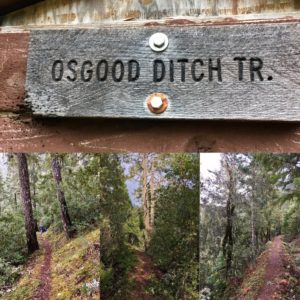
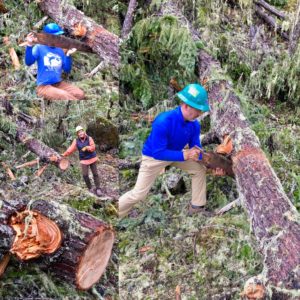
An experience of removing a fallen log on a classic Southern Oregon’s (“my wilderness backyard”) Osgood Ditch Trail with the  Siskiyou Mountain Club (a non-profit organization “We do the hard work it takes to keep the backcountry experience alive in the region we work”) provided great insight into how we handle the obstacles in our bodies and our lives. How we can utilize an experience as a teaching lesson for the journey of healing. Whether you are healing from an injury, or healing from trauma, you know what an arduous journey it can be to heal. It requires right effort often with precision and focus, unconventional means, awareness of surroundings and taking the time to assess all issues, team work with the ability to express your feelings & concerns to others, the appropriate tools, patience, perseverance and celebration. 

Let’s look at these fundamentals a lil bit more:

  • Right effort – Let the saw work for you. Use the body, as much of the body as you have available to your action(s), and watch the mind’s tendency to rush or push harder on the body than necessary. This was especially important because the unconventional means of under-bucking with the one man cross-cut saw. 

Alignment (precision) of the top cut for the undercut was essential to the process, being aware (focus and attention) of the opposites (top and bottom) and how they related made the process much more efficient. 

  • Team work – this requires including all members able to perform the task. The coordinated effort of “all parts,” or team members, makes the task an effective means to addressing the fallen log blocking the path. 

This is true of our bodies as well; use what’s available and coordinate as many parts of yourself to accomplish the task of “removing the obstacle.” 

  • Being aware of the surroundings – gather information from your senses about the situation and the surrounding variables that you can address to make the task a viable option and noticing the hazards or consequences to the task can help the situation. This also included being able to express your feelings & concerns for the task. Fear can be a big one, and noting that you fear something that may be a consequence to your actions is important. 

Hiding the fear keeps it unattended. 

With our leader in the task, she had the courage to address her fear to the group, the uphill part of the log potentially sliding down, was extremely important for all others to hear and acknowledge the risks involved. Naming what the fear was about allowed all of the team members to take note and be aware without giving up on removing the obstacle. We didn’t let the fear stop us from doing what needed to be done. 

It is very important in removing obstacles on your path, and journey of healing to notice your feelings, especially fear, and you stay focused on what you need to do without fear stopping you. 

  • The appropriate tools – and the skill it requires to remove the fallen tree from the path was vital. A two person saw might have been the best, but that would have required extra resources to carry it in and out, and since we did not know what obstacles we would find, and the number of people carrying tools into the wilderness, we choose to take the one person cross-cut saw. 

So we did what we could with the tools we had available. This required a lil more time and strategy knowing what we had, and multiple team members and patience were some of our virtues. And noting the potential challenges, such as binding and unknown tension in the log; or fault lines from how it grew, fell and broke on the terrain, provided us ample opportunities to use our tools with great skill in different ways to accomplish the removal. And avoid binding and loosing access to a very important tool. 

No need to push harder or faster if that risks breaking an important part of the system, and potentially loosing it completely for further actions in the task at hand,
or future obstacle.

  • Perseverance – was another cardinal quality in removing the obstacle.

At first you don’t succeed, try again. And try again. And try again.

Perhaps from another angle, with an additional tool, more team members or part of the team you didn’t know you had available but it all of a sudden came to your awareness you had that skill, or tool –  the hand saw. And using all of our senses, to inform us of how the practice was proceeding; such as the sliding sound of the fallen tree uphill, the cracking and separating, and the final release of cutting. 

  • Celebrating – But interesting how there was so much focus on cutting the log, that in the process of moving the cut piece off the trail all team members jumped in exuberantly and began moving the large piece without pausing and looking at the best direction and way to move it off the trail. A very discombobulating and potentially injurious situation for one or more of the team members; you could also say one of the systems in your body. 

In the release, the freeing “energy” and excitement keep your focus on the steps and doing what is fully required keeps your actions coordinated and integrated.

This happens a great deal, we are so excited when the obstacle is cut or broken through, we celebrate and let down our focus and attention. And in fact the cutting through is just one step along the process. Without good observation, continuing with integrating the cutting through with the rest of the essential tasks or actions, something can go awry. 

In that final stage, or integration, there can be re-injury, unresolved piece and set back. It was important to stop, review, and try to find the best way to take it completely off the path. 

Celebration is a great ingredient in the process of removing obstacles, and maintaining a clear middle way that keeps one from swaying to and from – comfort and discomfort, removal and return, contraction and relaxation, will keep one from noticing and utilizing what is in the obstacle and the end goal. 

Keeping your sights on what you really want is key to healing. Moving beyond pain relief is essential to living fully with the energy to address the next obstacle that comes across your path.

A prayer(song) for you:

“sthira  sukha  asana”
May you be courageous & steadfast
with the virtues of peace & happiness
 in the pursuit of your endeavors.

Filed Under: Insights, Moving Into Harmony, Yoga

Your Potential is at the Doorway’s Threshold.

January 10, 2020 by Shawn M Flot

“We’re living in a time where we each need a tremendous amount of courage —
a fierce kind of attention and intentionality.
The doorway is always through your pain and vulnerability,
the experience where you are open to the world whether you want to be or not.
I’ve come to consider vulnerability
as a form of imaginative intelligence,
and the good news is that it can be cultivated.
The real challenge is the pain that comes with vulnerable living.
When pain arises, it is tempting to say to yourself:
‘If this is the way that God is playing, no thanks, I’ll back up.’
Self-compassion is needed to understand this.
During and after the season of pain,
the question that comes up is:
‘Will I turn back to vulnerability, to living a wholehearted life?’”

~ David Whyte

When pain arrives at the doorstep of your awareness, do you move into the message from your body with courage? Do you recognize your ability to intentionally attend to any part of your body – a fierce kind of attention and intentionality – to follow what your body is calling for?

Living a wholehearted life.

Pain is described as a signal from within. It is not external. It is not foreign. It’s the language of the body asking for help. Asking for a different way to do things. The real challenge is the pain that comes with vulnerable living; the vulnerability to accept, once you listen to the body’s calling for balance and ease, to move in the direction of harmony and self-healing. How do you rediscover the flow of harmony?

The doorway is always through your vulnerability.

And in the vulnerability to life do you move with courage or do you fight, flee, or freeze? Courage comes from the root Norman French word cour, meaning the amount of heart you have in your life. Is there courage to participate in the unraveling of your being, to witness the shadows of your existence? Trace your shadows back to their source, toward expansion and receptivity. This is vulnerability.

Or, do other factors stronger than your courage send you in a direction of contraction?  These come from reaction, inaction and the mind’s directions that pull you away from harmony and your source of vitality.

When pain arises, it is tempting to say to yourself:
‘If this is the way that God is playing, no thanks, I’ll back up.’

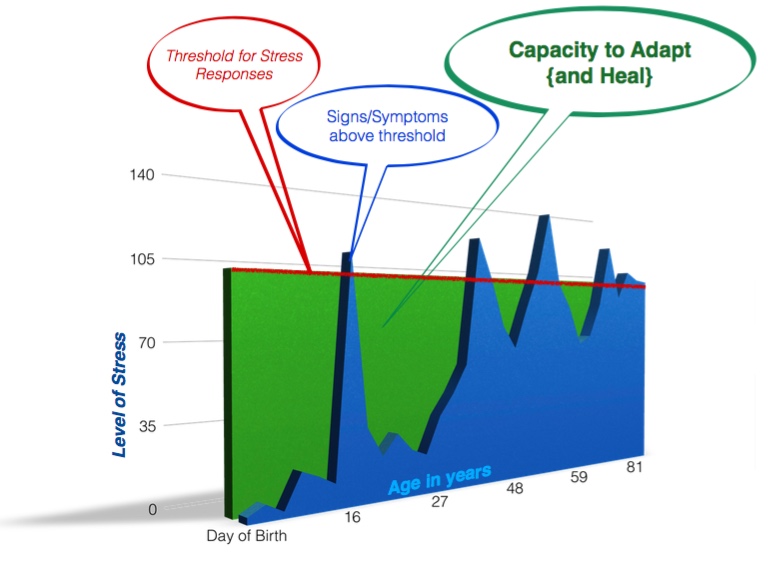
Actions of fight, flight or freeze create fixations in the body. Fixation requires the body to adapt. The body must compensate around these, sometimes in ways that shut off other vital functions that are initially unnoticed but, over time, become noticed. My teacher, Frank Lowen, says the body has amazing abilities to adapt, but that this is a finite amount, a finite space of living. Signs and Symptoms don’t become conscious until we use up the capacity to adapt. Meaning when the body has used up its abilities to adapt, it signals, “I can’t do this, this way anymore. Help!” These signals show up as degenerative processes, dis”ease” and pain.

copyright Moving Into Harmony, inc. 2015
Body’s Ability to Adapt Graph

When pain arises, can you discover ways to find more space? Can you have courage to step into the dark, into the unknown, into the silence inside yourself to willingly learn something consciously new from life itself?

A wedge of freedom inside your heart.

I say this with a great deal of compassion; Self-compassion is needed to understand this. With 20 years of clinical experience, I’ve observed many expressions of the body’s signal described as pain, and the responses to the body’s messages. Undoubtedly, pain is real, and the expression of pain is as individual as there are people in the world. Sometimes the volume of the pain signal is so loud, nothing else can be heard or felt. We can try as professionals to objectively measure pain, but to scientifically categorize this phenomenon is negating the individual experience, and therefore their interpretation and self-discovery.

“I’ve come to consider vulnerability as a form of imaginative intelligence,
and the good news is that it can be cultivated.

David Whyte describes imagination “is about your faith in the images inside you, the images of your particular way of belonging in the world.” A form of intelligence – imaginative, expressive, cultivated – from your ability to intentionally listen, discover and learn about the natural state of your being. We all have one thing in common: We are all trying to find our way back to harmony and experience divine Love. And our body “knows” this inherent desire, and will do anything to maintain a harmonious state. How amazing to know you have the potential to cultivate a deeper understanding and awareness to your existence with life. Cultivated from inquiry, the action of stepping through the threshold, out the door, exploring, discovering, recognizing, and integrating new experiences full of life; and knowing what you do on this day will make the days ahead greater.

Not new, but wholeheartedly and consciously new.

Filed Under: Insights, Moving Into Harmony

  • « Go to Previous Page
  • Page 1
  • Interim pages omitted …
  • Page 3
  • Page 4
  • Page 5
  • Page 6
  • Go to Next Page »

Primary Sidebar

Recent Articles

  • Beyond pain relief there is potential to do more
  • The Breath: Your Best Companion in Healing, Health & Performance
  • The truth about your breathing – the diaphragm Part 2

Categories

Footer

  • Facebook
  • Instagram
  • Vimeo
  • YouTube

Moving Into Harmony

109 S. 2nd Street
Talent, Oregon

Privacy Policy / Terms & Conditions / Disclaimer

Copyright © 2026 · Aspire 2.0.1 On Genesis Framework · WordPress · Log in